The situation
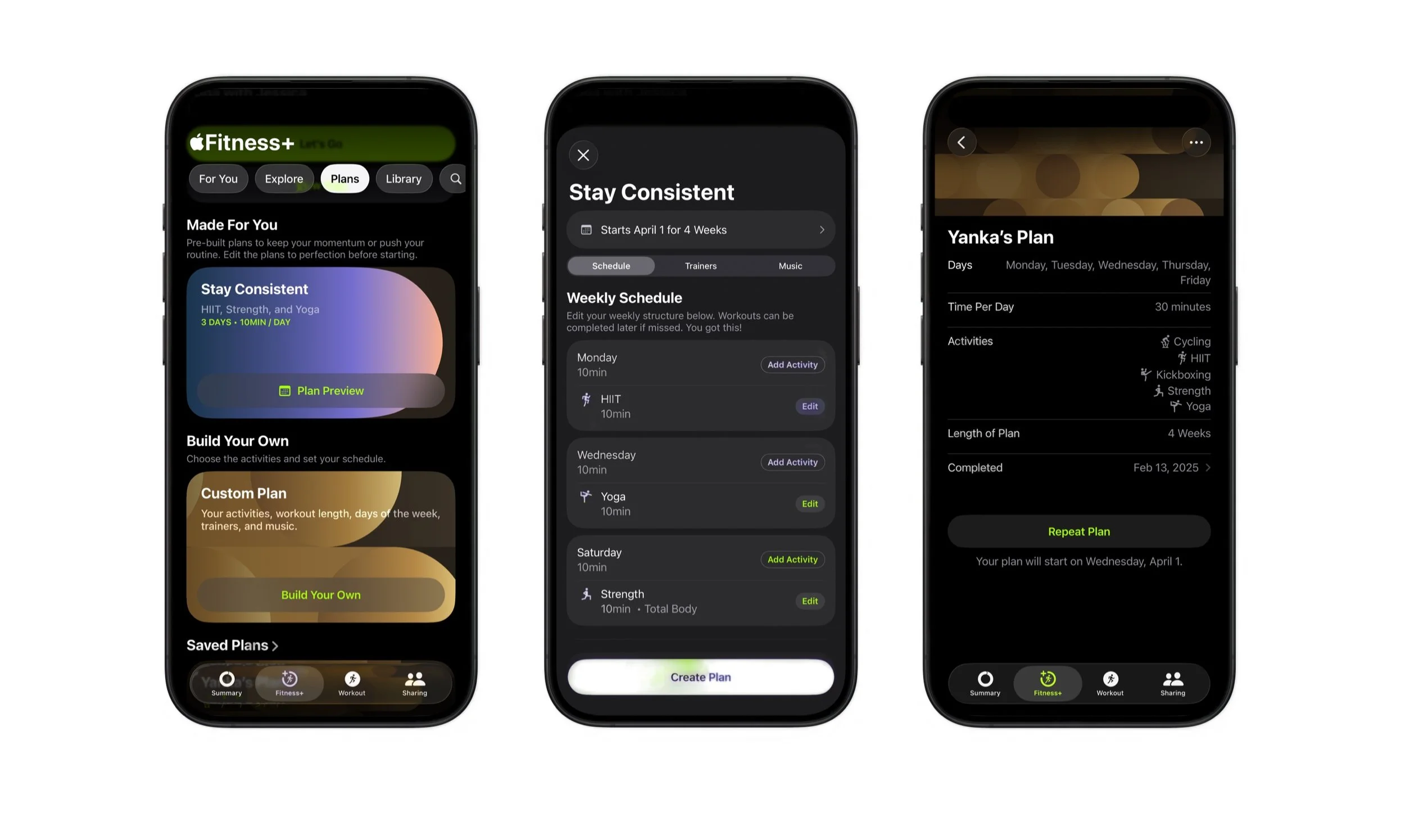
Fitness+ was editorially led from day one — human-programmed and taste-driven, with no personalization layer. That was the brand: a service with a point of view, not a content library. But a library with thousands of workouts and no way to surface what's right for you specifically makes the wrong ask of subscribers. The product team was building Custom Plans to close that gap. My job was to figure out how to introduce AI personalization without breaking the thing that made Fitness+ worth trusting.
The insight
I partnered with User Research to design a 40-interview qualitative study — not on general AI sentiment, but on reactions to three specific AI feature framings. The finding changed the brief. The dominant anxiety wasn't "can I trust AI?" It was "will it actually know me, or will it just give me what it gives everyone?" We didn't need to defend the technology. We needed to prove specificity.
What I built
A positioning framework built on the research, not the technology
I mapped five options from tech-forward to human-forward and stress-tested each against the research findings. "Your Personalized Trainer" won — relationship-forward, technology invisible. Apple Watch data handled the credibility layer in sub-copy. It answered "won't know me" without saying "AI" once.
Language guardrails that became the company template
"AI" and "algorithm" were banned as lead claims. Every rule had a consumer psychology rationale attached, so it held across teams, surfaces, and word counts. The brief wasn't a style guide — it was a decision tool. It was adopted as the template for every subsequent AI feature launch at Fitness+.
A content strategy across four surfaces — editorial and personalized
The For You carousel card lived on the personalized surface, where the feature promise matched the algorithmic context. The Explore tab card positioned Custom Plans on the editorial surface — framing it as a curated recommendation, not an algorithm output. The Activity Summary widget and Apple Store billboard rounded out the launch. Each surface had a different word budget and a different positioning job.
Product requirements written into the PMM brief
The creation flow had to feel like preference discovery, not form-filling. Trainer and music selections had to be soft filters — not hard constraints that could starve a plan of content variety. Positioning that the product couldn't deliver wasn't positioning — it was a liability.
A measurement framework defined before launch
Three tiers: 90-day adoption, plan completion and session frequency, and 30-day retention versus the general subscriber base. I built an attribution model with Data Science to control for self-selection bias. We separated cold-start subscribers from established ones because the personalization quality was different for each — and that distinction ended up shaping the entire next-generation roadmap.
Results
Custom Plans exceeded 90-day adoption targets. Subscribers who engaged showed measurably higher session frequency and retention versus the general base. The language guardrails brief was adopted across all subsequent AI launches. Within six months, Custom Plans became the primary daily engagement tool — and the post-launch cohort data directly shaped the next generation of Fitness+ personalization.
What this proves
I find the strategic tension everyone else is trying to smooth over — editorial versus algorithm, trust versus capability, human versus smart — and build the system that holds both. On this one, that meant diagnosing a consumer anxiety the team hadn't named yet, writing a positioning brief that defined what the product needed to be, and building the measurement framework that connected the launch to the roadmap. I don't just launch AI features. I figure out what they need to feel like before anyone trusts them.