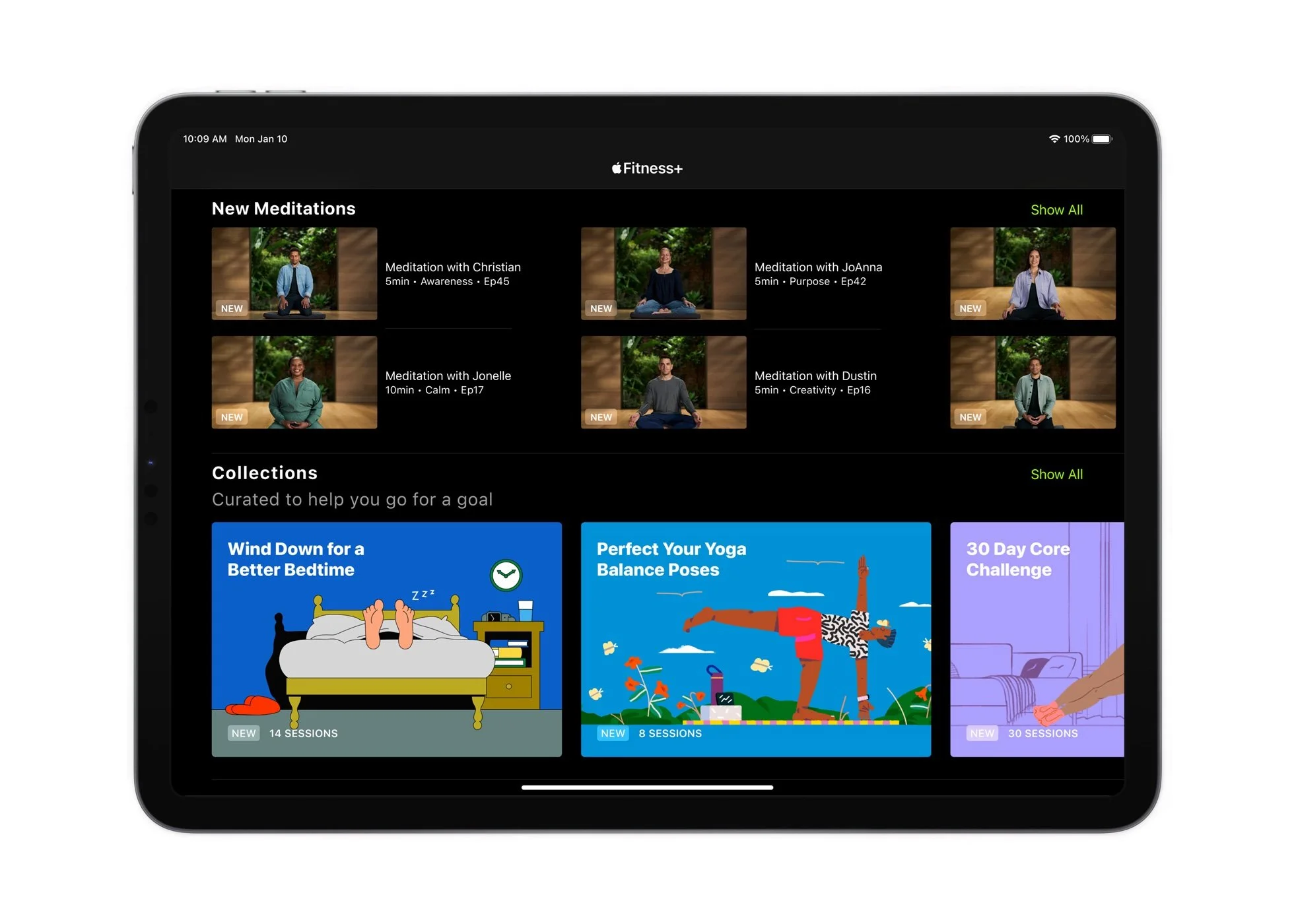
I pitched the feature. I owned the launch. Editorial Stories became one of Fitness+'s most-used discovery surfaces — and the proof point that human curation and algorithmic personalization compound when they're built together.
By 2022, Fitness+ had a discovery problem the algorithm couldn't solve alone. The library had grown big enough that beginners didn't know where to start. Advanced users couldn't see what came next. Both groups were churning at different points in the funnel.
The Brief
I pitched Editorial Stories — curated, story-driven collections built around specific user journeys — to product. Once it was approved, I owned the GTM launch.
What I Built
The funnel insight that built the case for the feature. I partnered with data science to map the discovery funnel from impression to repeat play across user segments. Two patterns emerged. Beginners had strong trial starts but dropped off between impression and first play. Advanced users engaged early but churned around week six without progression. One funnel, two leaks. That data was the spine of the pitch.
One feature, two audiences, two jobs. I framed Editorial Stories as a single feature solving two opposite problems.
For beginners. A guided on-ramp. "Get Started with Yoga." "Your First Strength Class." The path that turns curiosity into a first workout.
For advanced users. Structured progression. "Next Steps in Strength." "Build on Your Yoga Practice." The path that turns confidence into compounding habit.
Same feature. Two audiences. Two jobs. The dual frame is what got cross-functional buy-in across product, design, engineering, and marketing.
Where editorial meets the algorithm. Stories were the bridge between human curation and algorithmic personalization. Editors built the narratives. The algorithm showed the right Story to the right user at the right moment. The feature only worked because the two systems ran together. Personalization without editorial felt cold. Editorial without personalization couldn't scale.
A phased launch built around what data could prove. Phase 1: owned-channel only, US-only, four Stories first as a validation wave to confirm the funnel hypothesis — in-product hero placement, push to lapsed users, email to non-active subscribers, a social series with trainer-led intros. No paid media. Phase 2: paid plus YouTube creators added only once the data showed which Stories converted. Creator partnerships matched to audience, not follower count. Paid spend went only behind the proven winners.
A measurement architecture that read product and marketing in parallel. Product side was my primary lens — funnel from impression to completion, story-level conversion, retention lift on beginner versus advanced cohorts post-exposure, weekly active usage as the north star. Marketing side ran alongside — channel performance, exposed-vs-control lift, brand-layer survey. Apple's privacy architecture meant direct funnel attribution wasn't possible — the same constraint AI launches face today. So we triangulated. Three signals together told us which lever was working: owned, creator, or in-product placement.
The Moment it Got Tested
The biggest temptation was the paid-media push. The instinct was to launch with paid on day one — a big visible push, the kind that signals leadership commitment. The risk was bigger than the case: paid spend burns on the wrong content when you don't know which Stories convert.
I pushed back. Phase 1 owned-channel only, four Stories, a validation wave. Phase 2 paid plus creators only after data told us which Stories were working.
The team wanted scale on day one. I wanted signal first.
By Phase 2, paid went only behind the proven winners. Creator partnerships were audience-matched, not follower-counted. Cost per converting trial was meaningfully lower than a paid-on-day-one launch would have produced.
The Result
Editorial Stories became one of Fitness+'s most-used discovery surfaces. Meaningful lift in weekly participation. Real improvement in impression-to-play conversion. The dashboard I built with data science became the feedback loop the team used to keep building — over 50 Stories in the library today.
The biggest result wasn't the launch metrics. It was the model. The hybrid editorial-and-algorithm system became the proof point that earned leadership investment in personalization-driven curation across the broader product.
What This Proves
I see the structural problem before the team does — and build the system that fixes it.
Algorithm alone is cold. Editorial alone doesn't scale. The work is in the bridge.