AI-assisted dubbing was the gating decision for Apple's biggest international expansion ever. I made the case for it in 2025 — before it was the obvious move — and turned Japan into the new GTM playbook for every Fitness+ market expansion that followed.
In Japan, gym penetration is 3%. Mindfulness is a category, not a niche. Language isn't a feature — it's a prerequisite for trust. None of that translated from the US strategy. The positioning had to be rebuilt from the ground up.
The Brief
Apple's 2025 international expansion was the largest in Fitness+'s history — a single-year jump from 21 to 51 markets. Japan was the highest-stakes launch on the slate, with strong Watch penetration but a fitness culture nothing in our US strategy fit.
I led the GTM content and positioning strategy. Two non-negotiables had to be won before anything else could happen: full Japanese dubbing and locally-relevant music.
What I Built
The first positioning shift in any Fitness+ market launch. Every market before Japan had used a tightened version of the US positioning. For Japan, I rebuilt it.
From the US frame. Fitness for everyone. Gym-coded. Intensity-led — HIIT, strength. Studio sessions, 45 minutes. English-language with subtitles.
To the Japan frame. The rhythm that fits your day. Ritual-coded. Low-impact-led — yoga, walking, mindfulness. Short sessions for commutes and small apartments. Japanese as the foundation, not a feature.
This was a category-level rebuild of what Fitness+ needed to be in Japan. Not localization.
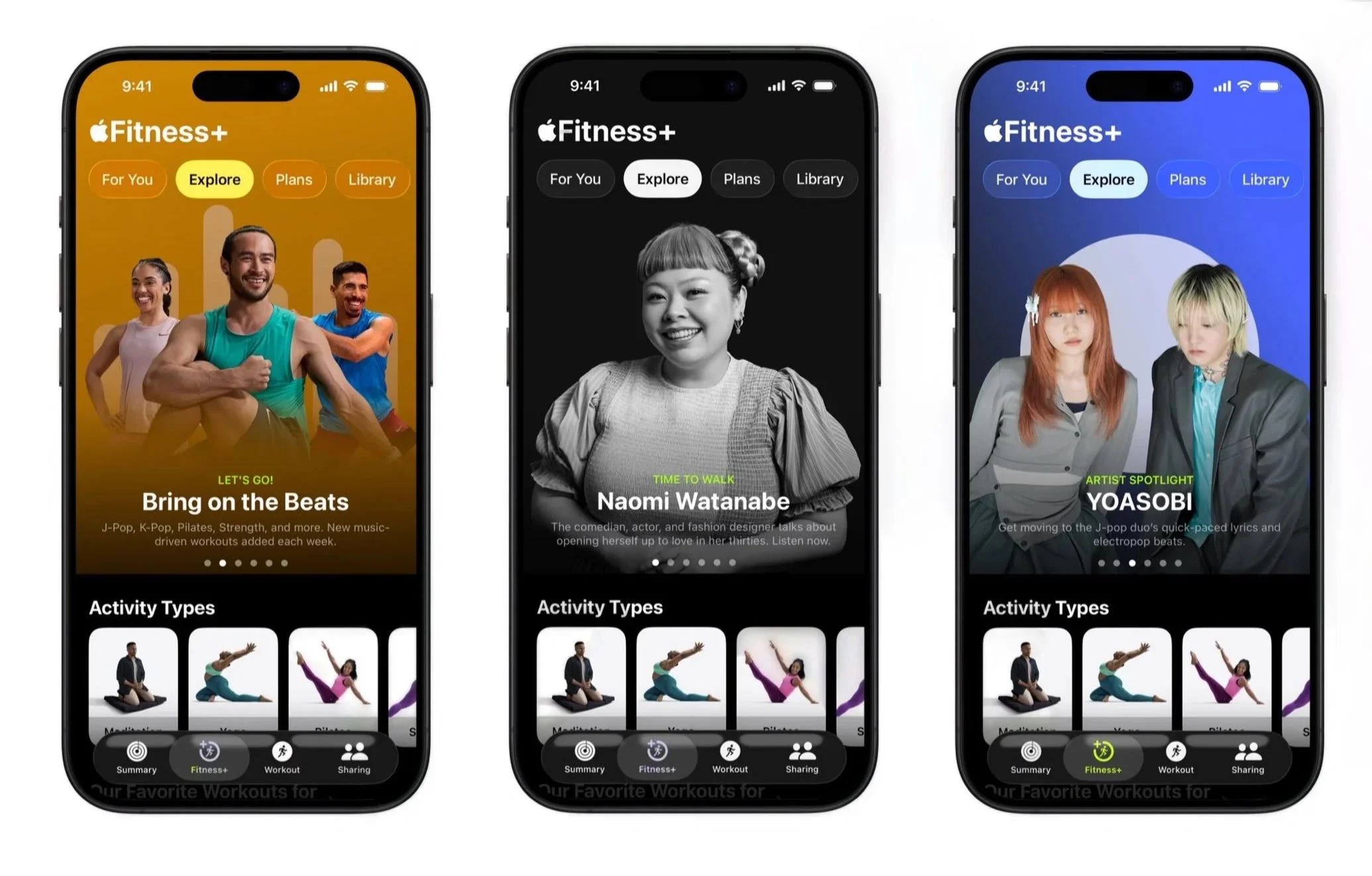
A custom content marketing strategy across the company. I led cross-functional alignment to ship one coordinated story across every channel. Cultural partnerships with Yoasobi, Tomohisa Yamashita, and Naomi Watanabe gave the launch its cultural hooks — the moments that signaled to a Japanese audience that this product was built for them.
A measurement approach that read product and marketing together. Apple's privacy constraints rule out chasing one funnel. So I built a triangulated framework — engagement signal, marketing reach, brand sentiment — read in parallel to tell the story of what the launch was actually doing.
A scalable GTM playbook for future market launches. What came out of Japan wasn't a one-off plan. It was the first market-expansion model Fitness+ had ever had — cultural research → positioning shift → non-negotiables → cross-functional orchestration → cultural-calendar ownership. Every Fitness+ market that launched after Japan used it.
The Moment it Got Tested
The hardest fight was dubbing. Apple had never dubbed Fitness+ at scale, and the default launch playbook was English-only with subtitles. AI-assisted dubbing was a meaningful ask. The easier read was to wait or pilot smaller.
I won the room with four moves.
I reframed the question. Not full vs. partial dubbing.Japan or no Japan. Without local-language coverage, we'd launch as the product built for America that's also available in Japan. Launch viability, not feature spec.
I quantified the case in marketing's language. Partnered with cross-functional teams to model the engagement risk and translated the output into stakes leadership could act on.
I built a phased path forward. Not a binary choice — a sequenced approach that gave leadership a real path, not a wall.
I anchored in Apple's quality bar. Quality is non-negotiable in a flagship market. That argument doesn't work everywhere. It does at Apple.
The launch shipped with dubbing. The engagement signal became the proof point that unlocked dubbing for every market expansion that followed.
The Result
The launch exceeded adoption expectations. Time to Walk and Meditation hit record-breaking numbers — categories that normally underperform in international markets. The Yoasobi Artist Spotlight became a proof point for future cultural partnerships across the region.
The biggest result wasn't the launch metrics. It was the playbook. What I built for Japan became the GTM model every Fitness+ market expansion has used since — and I still own the Japan relationship today, running cultural calendar coordination so product moments, content drops, and campaigns align with local rhythms we wouldn't know from the outside.
What This Proves
I don't localize products. I reposition them — and I keep running them after launch. Different country. Same muscle.