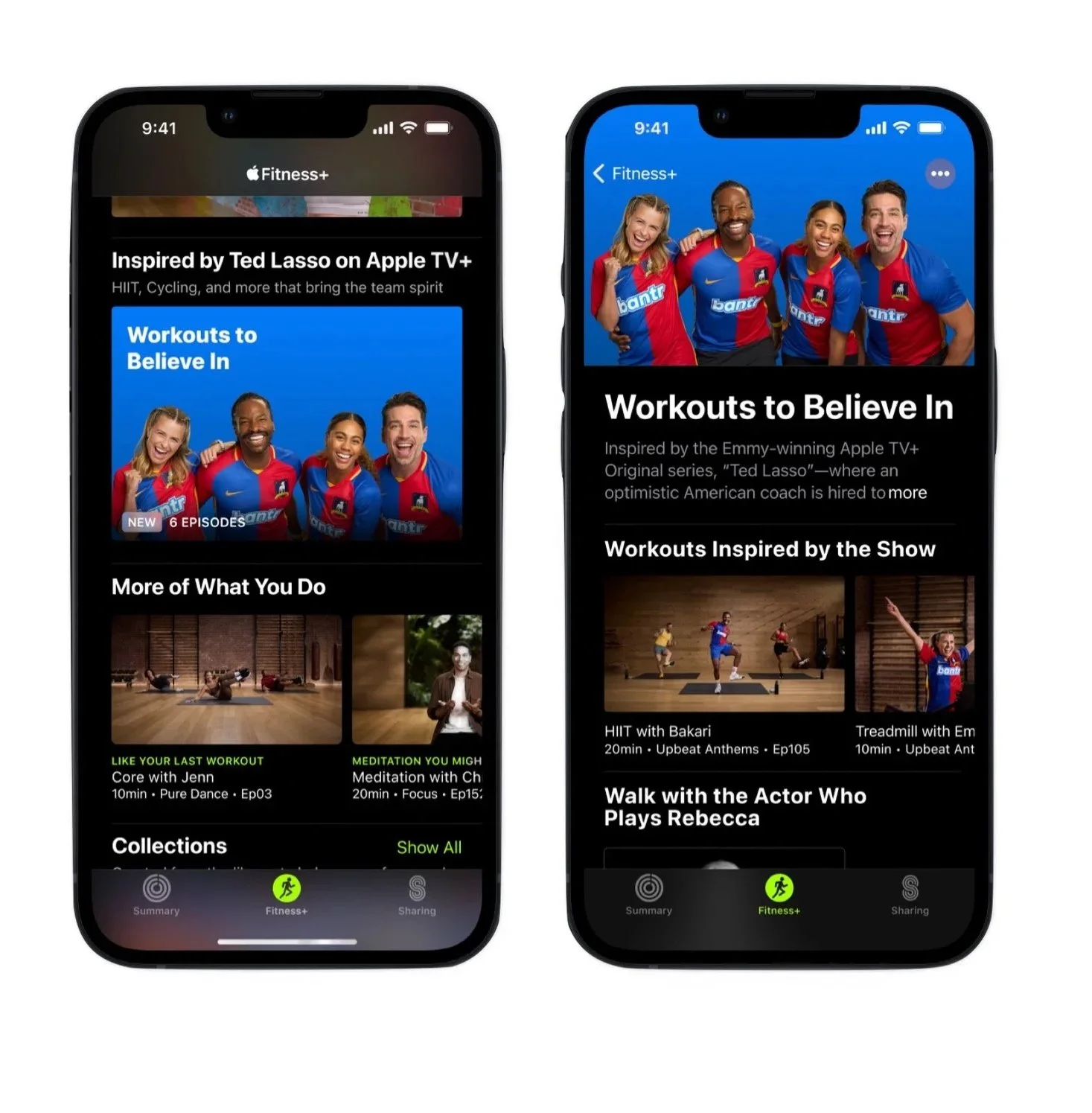
Apple's first cross-product ecosystem campaign wasn't assigned to me. I built it as a testable bet — and turned it into the framework Fitness+ has used for every cultural moment since.
A TV+ team brought me Ted Lasso Season 3 as a content partnership. What I saw was something different. The show's emotional territory — optimism, motivation, resilience — mapped almost exactly to the psychological drivers behind fitness habit formation. That wasn't a playlist opportunity. That was a hypothesis no one had tested inside Apple.
The Brief
In 2023, Apple's services were growing fast but operating in their own lanes. There was no shared infrastructure for coordinated storytelling and no playbook for cross-product ecosystem campaigns.
The hypothesis I wanted to test: when a user engages with multiple Apple products and services inside a single cultural moment, do they retain better?
Ted Lasso was the test case. Six teams had to align — TV+, Fitness+, Retail, PR, Legal, and App Store editorial. I had zero authority over any of them. The campaign was unassigned, the budget was zero, and the timeline was tied to Season 3's premiere.
What I Built
The non-obvious connection between a TV show and a fitness product. Most people heard Ted Lasso collab and thought content partnership. I heard a test case. The show wasn't about fitness — it was about what makes someone keep showing up. Believe is the core of Ted Lasso. It's also what Fitness+ actually sells. Nobody starts a workout unless they believe, on some level, they can do it. One word that worked in both directions.
A unifying creative platform that travelled. Believe became the platform that translated into every Apple-owned surface. Themed studio workouts in the Fitness+ catalog. The Believe sign built as a physical set piece into the production studio. Trainers in AFC Richmond jerseys. Time to Walk episodes with cast members. Cross-product integration linking the TV+ show page directly to Fitness+ workouts. Apple Newsroom press release timed to Season 3 premiere week. App Store Today story (earned, not paid). Coordinated email from both Fitness+ and TV+ marketing to their different subscriber bases. One creative platform, every surface.
Retail as durable channel, not display. This is the move most cross-product campaigns miss. Today at Apple sessions globally during the campaign window — and a durable update to how Retail talks about Fitness+ with every Watch buyer. A display ends when it comes down. A change in how the product gets sold every day is infrastructure.
A measurement approach designed for honest directional signal. Apple's privacy architecture meant I couldn't follow the same user across services — the same attribution problem AI launches face today. So I built a triangulated framework: direct, indirect, and directional signals, plus a guardrail to make sure the campaign was incremental, not redistributing attention from other workouts. I was explicit with leadership about what this could and couldn't prove. Designing for honest directional signal is what earned the right to fund the next ecosystem bet.
The Moment it Got Tested
The whole project was the test, but the moment that decided whether it would happen was the alignment phase. Six teams, zero authority, no playbook, no precedent.
I didn't run a big-room pitch. I sequenced.
Fitness+ first, because they were closest to the hypothesis. Easiest yes to get. TV+ second, mutual benefit, so they weren't being asked to take a one-sided bet. Then outward to Retail, PR, Legal, and App Store editorial — each with a specific, pre-mapped win.
By the time I reached the last team, two anchors were already committed. The conversation changed from "should we do this" to "how do we do this."
Momentum is its own form of authority.
The Result
The campaign drove a double-digit lift in Fitness+ engagement during the campaign window — incremental, not redistributed. Tier-1 press picked up the Season 3 premiere week. The trainer-led Instagram posts in AFC Richmond jerseys hit record per-trainer reach.
But the launch metrics weren't the result that mattered.
The result was the playbook.
Episode 1. Ted Lasso × Fitness+. The first cross-product ecosystem campaign at Apple.
Episode 2. F1 × Fitness+. Same architecture, bigger scale.
Episode 3. Messi × Fitness+. Global cultural figure. Refined the formula.
Episode 4. World Cup × Fitness+. June 2026.
Same framework. Four cultural moments. Still running. The hypothesis I was testing wasn't "does Ted Lasso work for Fitness+." It was "does this model work for any cultural moment we can pair with fitness." It does. It still does.
What This Proves
I build testable bets — and turn the ones that work into systems.Tactics end. Frameworks compound.